Blog

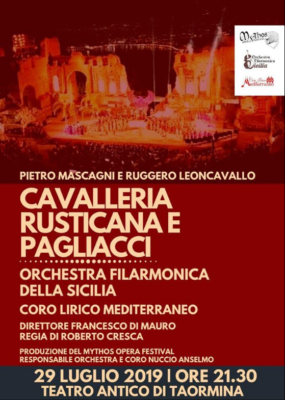
Cavalleria Rusticana & Pagliacci

Rustican Chivalry and Pagliacci (Clowns)

Opera by Pietro Mascagni and Ruggero Leoncavallo

Opera Mythos Festival

Ancient Theatre, Mondat 29th July 2019 @9.30pm


With the Sicilian Philarmonic Orchestra and Coro Lirico Mediterraneo directed by Nuccio Anselmo
Artistic Direction: Francesco Di Mauro
Direction: Roberto Cresca


TICKETS on boxol.itticketone.it and mythosoperafestival.it (more options here)
Gallery Platinum: € 95,00
Gallery Gold: € 65,00
Gallery Silver: € 52,00
Gallery Silver (promo until May 31st): € 48,00
Upper circle – Central: € 47,00
Upper circle – Lateral: € 37,00
Upper circle – Lateral (promo until May 31st): € 33,00
Upper circle (non-numbered seats): € 30,00


MORE INFO
www.mythosoperafestival.com
www.facebook.com/mythosoperafestival


————————————

CAVALLERIA RUSTICANA

Synopsis
Place: A 19th-century Sicilian village[10]
Time: Easter morning

Before the action takes place, the young villager Turiddu had returned from military service to find that his fiancée Lola had married the carter Alfio while Turiddu was away.[11] In revenge, Turiddu had seduced Santuzza, a young woman in the village. As the opera begins, Lola, overcome by her jealousy of Santuzza, has begun an adulterous affair with Turiddu.

The main square of the village

Offstage, Turiddu is heard singing a siciliana, “O Lola c’hai di latti la cammisa” (“O Lola! like the snow, pure in thy whiteness!”). To one side is the church; to the other is Lucia’s wine shop and the house where she lives with her son, Turiddu. The villagers move about the square, singing of the beautiful spring day, “Gli aranci olezzano sui verdi margini” (“The air is sweet with orange blossoms”) and a hymn to the Blessed Virgin Mary. Some villagers enter the church, and others wander off still singing.

Santuzza, having slept with Turiddu and suspecting that he has betrayed her for Lola, is distraught and approaches Lucia as she comes out of her house. Santuzza asks for Turiddu, but Lucia replies that he has gone to another town to fetch some wine. Santuzza tells her that he was seen during the night in the village. Lucia asks her inside to talk, but just at that moment Alfio arrives on his wagon, accompanied by the villagers. He praises the joys of a teamster’s life and the beauty of Lola his bride. Alfio asks Lucia for some of her fine old wine. She tells him it has run out and Turiddu has gone away to buy more. Alfio replies that he had seen Turiddu early that morning near his cottage. Lucia starts to express surprise, but Santuzza stops her.

Alfio leaves. The choir inside the church is heard singing the Regina Coeli. Outside, the villagers sing an Easter Hymn, “Inneggiamo, il Signor non è morto” (“We rejoice that our Saviour is living!”) joined by Santuzza. The villagers enter the church, while Santuzza and Lucia remain outside. Lucia asks Santuzza why she signalled her to remain silent when Alfio said that he had seen Turiddu that morning. Santuzza exclaims, “Voi lo sapete” (“You well know”) and tells Lucia the story of her seduction by Turiddu and his affair with Lola. Lucia pities Santuzza, who feels dishonored, having been seduced by Turiddu only to be abandoned by him for his old flame, Lola. Santuzza feels she cannot enter the church, but begs Lucia to go inside herself and pray for Santuzza who stays behind to try to plead with Turiddu to leave Lola and return to her.

Santuzza pleads with Turiddu that he not go to meet with Lola again.
Turiddu arrives. Santuzza upbraids him for pretending to have gone away, when he was actually seeing Lola. Lola enters the square singing. She mocks Santuzza and goes inside the church. Turiddu turns to follow Lola, but Santuzza begs him to stay. Turiddu pushes her away. She clings to him. He loosens her hands, throws her to the ground, and enters the church. Alfio arrives looking for Lola. Santuzza tells him that his wife has betrayed him with Turiddu. Alfio swears to take vendetta (revenge) which causes Santuzza to repent for having disclosed the affair and begs Alfio to stop to no avail.

The square is empty as the orchestra plays the famous Intermezzo.

Turiddu bites Alfio’s ear
The villagers come out of the church. Turiddu is in high spirits because he is with Lola and Santuzza appears to have gone. He invites his friends to his mother’s wine shop where he sings a drinking song, “Viva, il vino spumeggiante” (“Hail to the bubbling wine!”). Alfio joins them. Turiddu offers him wine, but he refuses it. All understand that trouble is in the air. The women leave, taking Lola with them. In a brief exchange of words, Alfio challenges Turiddu to a duel. Following Sicilian custom, the two men embrace, and Turiddu, in a token of acceptance, bites Alfio’s ear, drawing blood which signifies a fight to the death. Alfio leaves and Turiddu calls Lucia back. He tells her that he is going outside to get some air and asks that she be a kindly mother to Santuzza if he should not return: “Un bacio, mamma! Un altro bacio!—Addio!” (“One kiss, mother! One more kiss! – Farewell!”).

Turiddu rushes out. Lucia, weeping, wanders aimlessly around outside her house. Santuzza approaches and throws her arms around her. The villagers start to crowd around. Voices are heard in the distance and a woman cries, “They have murdered Turiddu!” Santuzza faints and Lucia collapses in the arms of the women villagers.

————————————

PAGLIACCI

Synopsis
Place: Calabria, near Montalto, on the Feast of the Assumption
Time: between 1865 and 1870

Prologue
During the overture, the curtain rises. From behind a second curtain, Tonio, dressed as his commedia character Taddeo, addresses the audience (Si può?… Si può?… Signore! Signori! … Un nido di memorie). He reminds the audience that actors have feelings too, and that the show is about real people.

Act 1
At three o’clock in the afternoon, the commedia troupe enters the village to the cheering of the villagers. Canio describes the night’s performance: the troubles of Pagliaccio. He says the play will begin at “ventitré ore”, an agricultural method of time-keeping that means the play will begin an hour before sunset.[note 3] As Nedda steps down from the cart, Tonio offers his hand, but Canio pushes him aside and helps her down himself.

The villagers suggest drinking at the tavern. Canio and Beppe accept, but Tonio stays behind. The villagers tease Canio that Tonio is planning an affair with Nedda. Canio warns everyone that while he may act the foolish husband in the play, in real life he will not tolerate other men making advances to Nedda. Shocked, a villager asks if Canio really suspects her. He says no, and sweetly kisses her on the forehead. As the church bells ring vespers, he and Beppe leave for the tavern, leaving Nedda alone.

Nedda is frightened by Canio’s vehemence (Qual fiamma avea nel guardo), but the birdsong comforts her (Stridono lassù). Tonio returns and confesses his love for her, but she laughs. Enraged, Tonio grabs Nedda, but she takes a whip, strikes him and drives him off. Silvio, who is Nedda’s lover, comes from the tavern, where he has left Canio and Beppe drinking. He asks Nedda to elope with him after the performance and, though she is afraid, she agrees. Tonio, who has been eavesdropping, leaves to inform Canio so that he might catch Silvio and Nedda together. Canio and Tonio return and, as Silvio escapes, Nedda calls after him, “I will always be yours!”

Canio chases Silvio, but does not catch him and does not see his face. He demands that Nedda tell him the name of her lover, but she refuses. He threatens her with a knife, but Beppe disarms him. Beppe insists that they prepare for the performance. Tonio tells Canio that her lover will give himself away at the play. Canio is left alone to put on his costume and prepares to laugh (Vesti la giubba – “Put on the costume”).

Act 2
As the crowd arrives, Nedda, costumed as Colombina, collects their money. She whispers a warning to Silvio, and the crowd cheers as the play begins.

Colombina’s husband Pagliaccio has gone away until morning, and Taddeo is at the market. She anxiously awaits her lover Arlecchino, who comes to serenade her (O Colombina) from beneath her window. Taddeo returns and confesses his love, but she mocks him. She lets Arlecchino in through the window. He boxes Taddeo’s ears and kicks him out of the room, and the audience laughs.

Arlecchino and Colombina dine, and he gives her a sleeping potion to use later. When Pagliaccio returns, Colombina will drug him and elope with Arlecchino. Taddeo bursts in, warning that Pagliaccio is suspicious of his wife and is about to return. As Arlecchino escapes through the window, Colombina tells him, “I will always be yours!”

As Canio (as Pagliaccio) enters, he hears Nedda (as Colombina) and exclaims “Name of God! Those same words!” He tries to continue the play, but loses control and demands to know her lover’s name. Nedda, hoping to keep to the performance, calls Canio by his stage name “Pagliaccio,” to remind him of the audience’s presence. He answers with his arietta: No! Pagliaccio non son! He sings that if his face is pale, it is not from the stage makeup but from the shame she has brought him. The crowd, impressed by his emotional performance, which they do not realize is real, cheers him.

Nedda, trying to continue the play, admits that she has been visited by the innocent Arlecchino. Canio, furious and forgetting the play, demands the name of her lover. Nedda swears she will never tell him, and it becomes apparent that they are not acting. Beppe asks Tonio to intervene, but Tonio refrains and prevents Beppe from halting the action. Silvio begins to fight his way toward the stage. Canio, grabbing a knife from the table, stabs Nedda. As she dies, she calls: “Help! Silvio!” Silvio attacks Canio, but Canio kills Silvio also. The horrified audience then hears the celebrated final line:

La commedia è finita! – “The comedy is finished!”


Arte Sicilia Contemporanea

Suggestioni ed echi dall’Antica Naxos

by Francesco Messina

Palazzo Ciampoli, from Monday 15 April to Saturday 15 June 2019

Open every day 9.00am – 7.30pm

Free Entrance


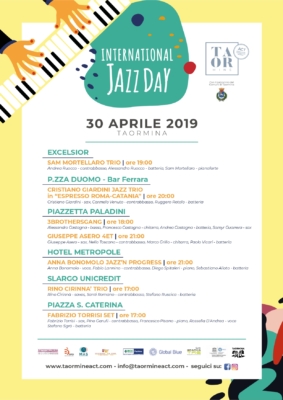
International Jazz Day

Taormina, April 30th 2019


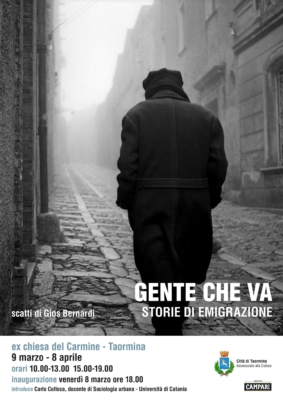
GENTE CHE VA

Storie di emigrazione

by Gios Bernardi

Ex Church “Del Carmine”, from March 9th to April 8th 2019

Opening hours: 10.00am-1.00pm and 3.00pm-7.00pm


Gios Bernardi takes these photographs during the Fifties and Sixties, in Sicily.
These pictures witness the so called “second emigration” of the Sicilian people. Men, women and children leaving their homes and families; their journeys; their new homes.
An exhibition that talks of struggles, hopes and  fears.


more info
https://taormina.comune.digital/mostre/c/0/i/31094725/gente-che-va-storie-di-emigrazione


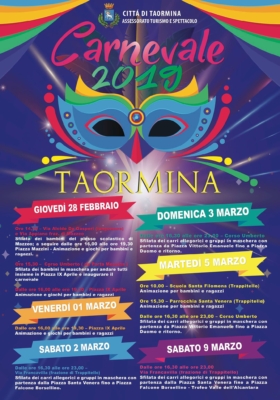
Taormina, Various locations, from Thursday 28th February to Saturday 9 March 2019


Carnival is a Western Christian festive season that occurs before the liturgical season of Lent. The main events typically occur during February or early March, during the period historically known as Shrovetide (or Pre-Lent). Carnival typically involves a public celebration and/or parade combining some elements of a circus, masks, and a public street party. People wear masks and costumes during many such celebrations, allowing them to lose their everyday individuality and experience a heightened sense of social unity. Common features of carnival include mock battles such as food fights; social satire and mockery of authorities; the grotesque body displaying exaggerated features, especially large noses, bellies, mouths, and phalli, or elements of animal bodies; abusive language and degrading acts; depictions of disease and gleeful death; and a general reversal of everyday rules and norms.


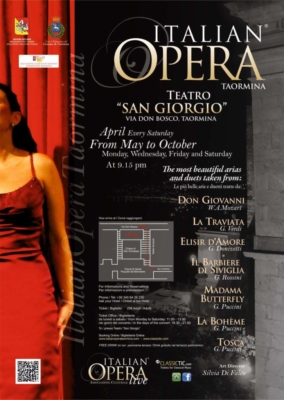
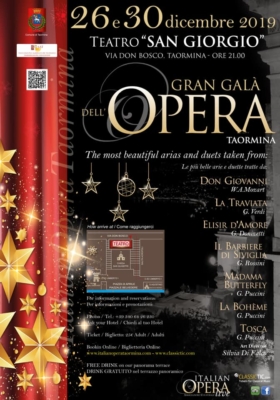
Italian Opera Taormina

Taormina Italian Opera 2019

San Giorgio  Theatre (via Don Bosco, behind piazza IX April) @ 9.15 pm
It is recommended to arrive 30 mins before the show


in April > every Saturday
from May to October > every Monday, Wednesday, Friday and Saturday

€ 25,00 entrance, drink included.
Kids under 10: free entrance

Info and booking: mobile 0039 340 6426230 – info@italianoperataormina.com
Online tickets >> http://www.italianoperataormina.com/wordpress/acquista-biglietti


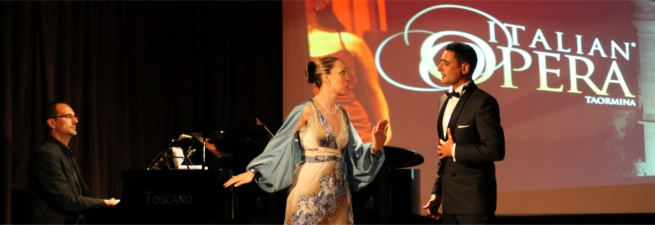
Do you love Opera music? The artists of the Italian Opera Taormina perform every week in Taormina. More than one hour of timeless arias from some of the most famous Italian operas.

An extraordinary journey with the most famous arias and duet from “Italian Operas”. You will hear music from great Italian operas interpreted by professional singers who have performed in the most important Italian and international theatres, performed with piano accompaniment.

The evening will be held in the Cine Teatro ‘San Giorgio’ where you will be offered a drink and can take in an extraordinary panorama view of Taormina.


Program changes every night.
Here you can have a look at the program of each evening:

January 17January 23January 30

February 11


APRIL
Sat 6Sat 13Sat 20Sat 27

MAY
Wed 1 – Fri 3 –  Sat 4 – Mon 6 – Wed 8 – Fri 10 – Sat 11 – Mon 13 – Wed 15 – Fri 17 – Sat 18 – Mon 20 – Wed 22 – Fri 24 – Sat 25 – Mon 27 – Wed 29 – Fri 31

JUNE
Sat 1 – Mon 3 – Wed 5 – Fri 7 – Sat 8 – Mon 10 – Wed 12 – Fri 14 – Sat 15 – Mon 17 – Wed 19 – Fri 21 – Sat 22 – Mon 24 – Wed 26 – Fri 28 – Sat 29

JULY
Mon 1 – Wed 3 – Fri 5 – Sat 6 – Mon 8 – Wed 10 – Fri 12 – Sat 13 – Mon 15 – Wed 17 – Fri 19 – Sat 20 – Mon 22 – Wed 24 – Fri 26 – Sat 27 – Mon 29 – Wed 31

AUGUST
Fri 2 – Sat 3 – Mon 5Thu 8Fri 9Sat 10Mon 12Wed 14Fri 16Sat 17Mon 19Wed 21Fri 23Sat 24Mon 26Wed 28Fri 30Sat 31

SEPTEMBER
Mon 2Wed 4 – Fri 6 – Sat 7 – Mon 9 – Wed 11 – Fri 13 – Sat 14 (International Music Fest) – Mon 16 – Wed 18 – Fri 20 – Sat 21 – Mon 23 – Wed 25 – Fri 27 – Sat 28 – Mon 30

OCTOBER
Wed 2 – Fri 4  – Sat 5 – Mon 7 – Wed 9 – Fri 11 – Sat 12 – Mon 14 – Wed 16 – Fri 18 – Sat 19 – Mon 21 – Wed 23 – Fri 25 – Sat 26 – Mon 28 – Wed 30

NOVEMBER
Fri 1Sat 2Wed 6Wed 13Wed 20Wed 27

DECEMBER
Wed 4Wed 11Wed 18 – Sat 28


SPECIAL CHRISTMAS OPERA CONCERTS

Thu 26  Mon 30

December 2019


WHERE TO STAY

Hotel La Pensione SvizzeraHotel Villa SchulerHotel Villa DucaleHotel Villa Carlotta


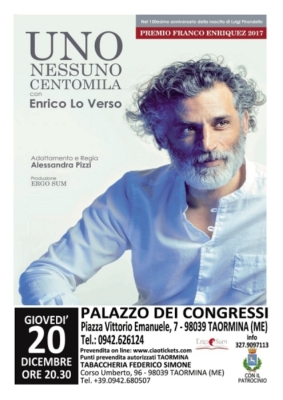
Uno Nessuno Centomila

One, No one and One Hundred Thousand

A play based on the namesake novel by Luigi Pirandello

Taormina Congress Hall, Sunday 6 January 2019 @ 8.30pm


A monolgue acted by the great Italian actor Enrico Lo Verso in a minimal stage set


Tickets

online >> soon on www.ciaotickets.com
ticket office >> Tabaccheria Federico Simone, Corso Umberto n. 96 Taormina (T. 009 0942 680507)
More info: 0039 327 9097113


Plot of  the novel
Vitangelo Moscarda discovers by way of a completely irrelevant question that his wife poses to him that everyone he knows, everyone he has ever met, has constructed a Vitangelo persona in their own imagination and that none of these personas corresponds to the image of Vitangelo that he himself has constructed and believes himself to be. The reader is immediately immersed in a cruel game of falsifiying projections, mirroring the reality of social existence itself, which imperiously dictate their rules. As a result, the first, ironic “awareness” of Vitangelo consists in the knowledge of that which he definitely is not; the preliminary operation must therefore consist in the spiteful destruction of all of these fictitious masks. Only after this radical step toward madness and folly in the eyes of the world can Vitangelo finally begin to follow the path toward his true self. He discovers, though, that if his body can be one, his spirit certainly is not. And this Faustian duplicity gradually develops into a disconcerting and extremely complex multiplicity. How can one come to know the true foundation, the substate of the self? Vitangelo seeks to catch it by surprise as its shows itself in a brief flash on the surface of consciousness. But this attempt at revealing the secret self, chasing after it as if it were an enemy that must be forced to surrender, does not give the desired results. Just as soon as it appears, the unknown self evaporates and recomposes itself into the familiar attitudes of the superficial self. In this extremely modern Secretum where there is no Saint Augustine to indicate, with the profound voice of conscience, the absolute truth to desire, where desperation is entrusted to a bitter humorism, corrosive and salvific at the same time, the unity of the self disintegrates into diverse stratifications. Vitangelo is one of those “…particularly intelligent souls …who break through the illusion of the unity of the self and feel themselves to be multiform, a league of many Is…” as Hermann Hesse notes in the Dissertation chapter of Steppenwolf.

Vitangelo’s extremely lucid reflections seek out the possible objections, confine them into an increasingly restricted space and, finally, kill them with the weapons of rigorous and stringent argumentation. The imaginary interlocutors, (“Dear sirs, excuse me”…”Be honest now”…”You are shocked? Oh my God, you are turning pale”…), which incarnate these objections rather than opening up Vitangelo’s monologue into a dialogue fracture it into two levels: one external and falsely reassuring, the other internal and disquieting, but surely more true. The plural you (“voi”) which punctuates like a returning counterpoint all of the initial part of the novel is much different from the “tu” of Eugenio Montale, which is almost always charged with desperate expectations or improbable alternatives to existence; it represents, rather, the barrier of the conformist conceptions which the lengthy ratiociations of Vitangelo nullify with the overwhelming evidence of implacable reflections.

Vitangelo’s “thinking out loud”, definitely intentional and rigorous, is, however, paradoxically projected toward a completely different epilogue in which the spiral of reasoning gives way to a liberating irrationalism. Liberation for Vitangelo cannot happen through instinct or Eros, as happens in the case of Harry Haller, the steppenwolf, who realizes his metamorphosis through an encounter with the transgressively vital Hermine. Vitangelo’s liberation must follow other avenues; he must realize his salvation and the salvation of his reason precisely through an excess of reason. He seems to say to us: “Even reason, dear sirs, if it is alleviated of its role as a faculty of good sense which councels adaptation to historical, social and existential “reality”, can become a precious instrument of liberation.” This is not true because reason, when pushed to its ultimate limits, can open up to new metaphysical prospects, but because, having reached its limits, deliriously wandering around in cerebreal labyrinths and in an atmosphere satured with venom, it dies by its own hand. The total detachment of Vitangelo from false certainties is fully realized during a period of convalescence from illness. Sickness, in Pirandello as in many other great writers, is experienced as a situation in which all automatic behavior is suspended and the perceptive faculties, outside of the normal rules, seem to expand and see “with other eyes.” In this moment the ineptitude that Vitangelo shares with Mattia Pascal and other literary characters of the beginning of the 20th century demonstrates its positive potential and becomes a conscious rejection of any role, of any function, of any perspective based on a utilitaristic vision. The episode of the woolen blanket signals the unbrigeable distance which now separates Vitangelo from the rules of reality in which the judge who has come to interrogate him appears to be completely enmeshed. While the scrupulous functionary, completely absorbed in his role, collects the useful elements for his sentencing, Vitangelo contemplates with “ineffable delight” the woolen blanket covering his legs: “I saw the countryside: as if it were all an endless carpet of wheat; and, hugging it, I was beatified, feeling myself truly, in the midst of all that wheat, with a sense of immemorial distance that almost cause me anguish, a sweet anguish. Ah, to lose oneself there, lay down and abandon oneself, just like that among the grass, in the silence of the skies: to fill one’s soul with all that useless blue, sinking into it every thought, every memory!”

Once cured of his illness, Vitangelo has a completely new perspective, completely “foreign”. He no longer desires anything and seeks to follow moment by moment the evolution of life in him and the things that surround him. He no longer has any history or past, he is no longer in himself but in everything around and outside of him.
(source: Wikipedia)

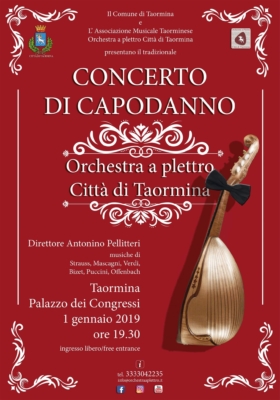
The Town of Taormina and the Taormina Plectrum Orchestra presents

The New Year’s Concert

Taormina Congress Hall @ 7.30pm

Free entrance


Antonio Pellitteri will conduct the Orchestra as usual. Music by Strauss, Mascagni, Verdi, Bizet, Puccini, Offenbach


More info
Plectrum Orchestra Town of Taormina: info@orchestraplettro.it – T. 0039 333 3042235 (mobile) – FB page


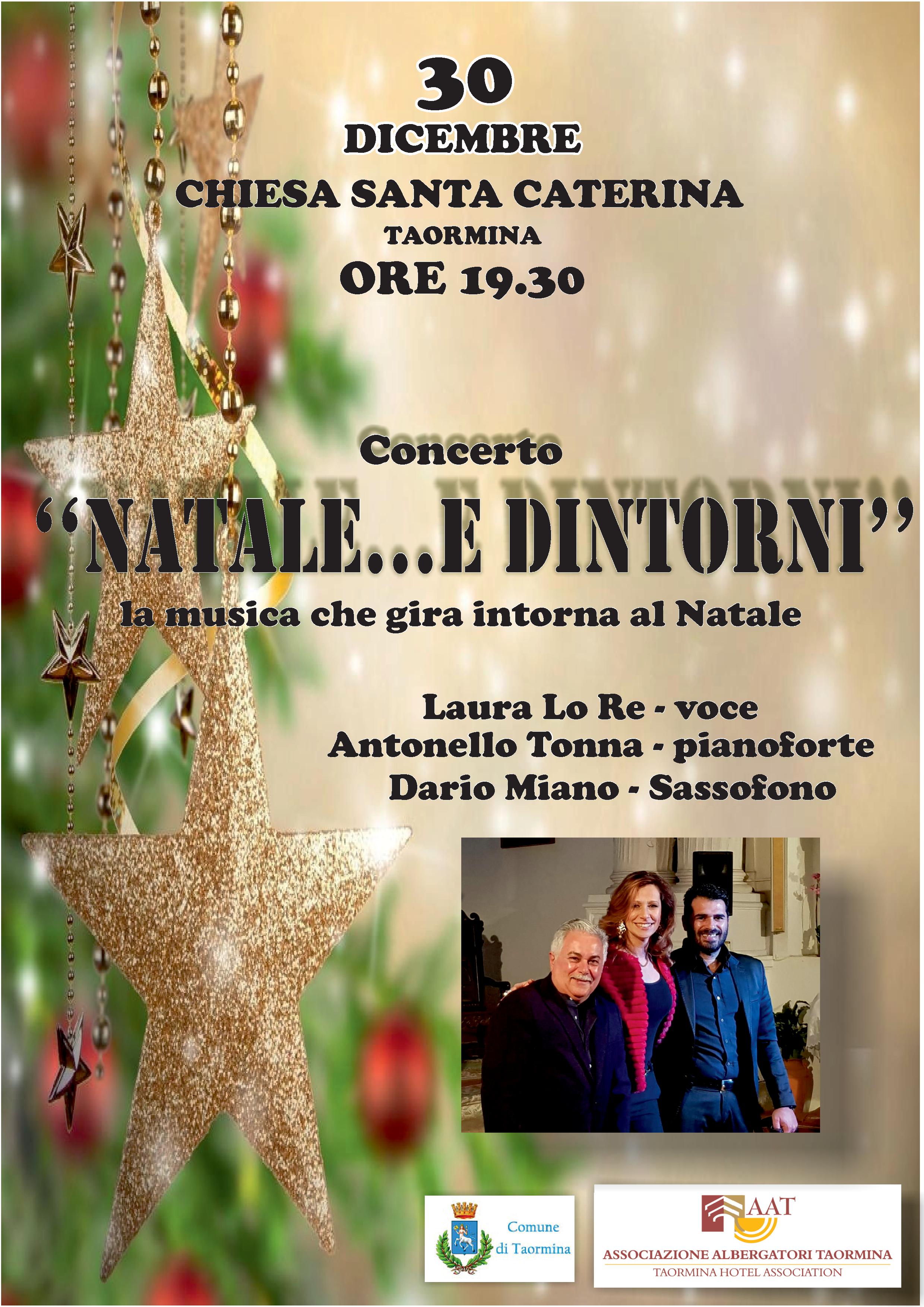
Natale… e dintorni

musics “around” Christmas

Church of Santa Caterina (via Giovanni di Giovanni), Sunday 30th Decemver 2018 @7.30pm


Laura lo Re: voice

Antonello Tonna: piano

Dario Miano: sax

Living Presepe – Living Nativity Scene

… e la Luce brillò… Venite e vedete!

15th edition – 2018

From December 26 2018 to January 6 2019

Parrocchia Sacro Cuore di Gesù –Trappitello,  Taormina (ME)

FREE ENTRANCE

The presepe will be held in case of rain too.


During Christmas time in Italy, you are bound to come across cribs in homes and piazzas all over the country. Many cities also have a living crib, or a living nativity scene. It is thought that St. Francis hosted the first living nativity scene in 1223, sparking a tradition that continues in Italy to this day. Beginning on Christmas day, and running until January 6th, towns throughout Italy hold pageants to re-act the night of Jesus’ birth. Actors portray Mary, Joseph, the three Magi and other biblical figures from the gospel.

In Trappitello, hamlet of the town of Taormina, every year in Chrismas time, a Living Crib with about 150 actors and “walk-ons” is organised. It is one of the most appreciated living cribs of Sicily and in fact last year 23.000 people visited the event. The Show lasts several days, from Christmas to half January. The location set is the huge garden of the old small church of Santa Venera.

– 26 December 2018 – 5.00pm / 9.00pm
– 27 Dicembre 2018 – 6.00pm / 9.00pm
– 29 Dicembre 2018 – 6.00pm / 9.00pm
– 30 Dicembre 2018 – 6.00pm / 9.00pm
– 1 January 2019 –  6.00pm / 9.00pm
– 2 January 2019 –  6.00pm / 9.00pm
– 4 January 2019 –  6.00pm / 9.00pm
– 5 January 2019 –  5.00pm / 9.00pm
– 6 January 2019 – 5.00pm / 9.00pm

Before you leave, food tasting

How to get there:  Motorway A18 Messina/Catania, exit Taormina, Direction SS. 185 (statal road, blu sign),  500 metres from the motorway exit.
More info: T. +39 0942/50210 – M. +39 339/8320324 – +39 349/4289961

presepetrappitello@gmail.com

Facebook page: Presepe Vivente di Trappitello