Blog

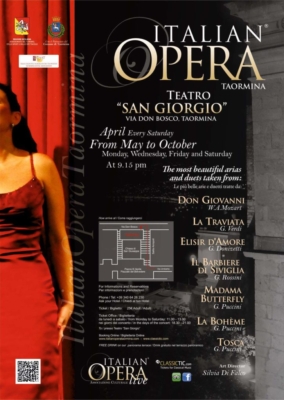
Italian Opera Taormina

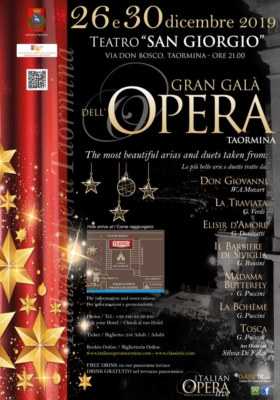
Taormina Italian Opera 2019

San Giorgio  Theatre (via Don Bosco, behind piazza IX April) @ 9.15 pm
It is recommended to arrive 30 mins before the show


in April > every Saturday
from May to October > every Monday, Wednesday, Friday and Saturday

€ 25,00 entrance, drink included.
Kids under 10: free entrance

Info and booking: mobile 0039 340 6426230 – info@italianoperataormina.com
Online tickets >> http://www.italianoperataormina.com/wordpress/acquista-biglietti


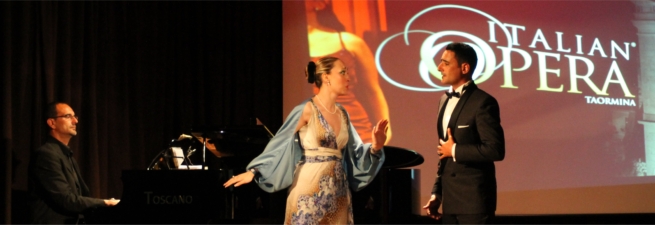
Do you love Opera music? The artists of the Italian Opera Taormina perform every week in Taormina. More than one hour of timeless arias from some of the most famous Italian operas.

An extraordinary journey with the most famous arias and duet from “Italian Operas”. You will hear music from great Italian operas interpreted by professional singers who have performed in the most important Italian and international theatres, performed with piano accompaniment.

The evening will be held in the Cine Teatro ‘San Giorgio’ where you will be offered a drink and can take in an extraordinary panorama view of Taormina.


Program changes every night.
Here you can have a look at the program of each evening:

January 17 – January 23 – January 30

February 11


APRIL
Sat 6 – Sat 13 – Sat 20 – Sat 27

MAY
Wed 1 – Fri 3 –  Sat 4 – Mon 6 – Wed 8 – Fri 10 – Sat 11 – Mon 13 – Wed 15 – Fri 17 – Sat 18 – Mon 20 – Wed 22 – Fri 24 – Sat 25 – Mon 27 – Wed 29 – Fri 31

JUNE
Sat 1 – Mon 3 – Wed 5 – Fri 7 – Sat 8 – Mon 10 – Wed 12 – Fri 14 – Sat 15 – Mon 17 – Wed 19 – Fri 21 – Sat 22 – Mon 24 – Wed 26 – Fri 28 – Sat 29

JULY
Mon 1 – Wed 3 – Fri 5 – Sat 6 – Mon 8 – Wed 10 – Fri 12 – Sat 13 – Mon 15 – Wed 17 – Fri 19 – Sat 20 – Mon 22 – Wed 24 – Fri 26 – Sat 27 – Mon 29 – Wed 31

AUGUST
Fri 2 – Sat 3 – Mon 5 – Thu 8 – Fri 9 – Sat 10 – Mon 12 – Wed 14 – Fri 16 – Sat 17 – Mon 19 – Wed 21 – Fri 23 – Sat 24 – Mon 26 – Wed 28 – Fri 30 – Sat 31

SEPTEMBER
Mon 2 – Wed 4 – Fri 6 – Sat 7 – Mon 9 – Wed 11 – Fri 13 – Sat 14 (International Music Fest) – Mon 16 – Wed 18 – Fri 20 – Sat 21 – Mon 23 – Wed 25 – Fri 27 – Sat 28 – Mon 30

OCTOBER
Wed 2 – Fri 4  – Sat 5 – Mon 7 – Wed 9 – Fri 11 – Sat 12 – Mon 14 – Wed 16 – Fri 18 – Sat 19 – Mon 21 – Wed 23 – Fri 25 – Sat 26 – Mon 28 – Wed 30

NOVEMBER
Fri 1 – Sat 2 – Wed 6 – Wed 13 – Wed 20 – Wed 27

DECEMBER
Wed 4 – Wed 11 – Wed 18 – Sat 28


SPECIAL CHRISTMAS OPERA CONCERTS

Thu 26  Mon 30

December 2019


WHERE TO STAY

Hotel La Pensione Svizzera – Hotel Villa Schuler – Hotel Villa Ducale – Hotel Villa Carlotta


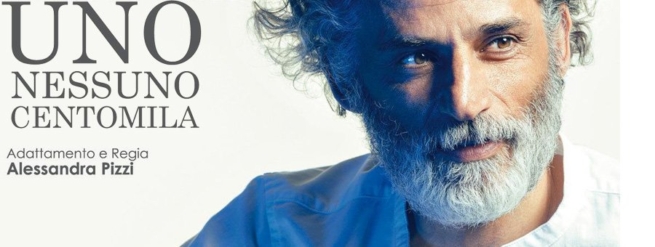
Uno Nessuno Centomila

One, No one and One Hundred Thousand

A play based on the namesake novel by Luigi Pirandello

Taormina Congress Hall, Sunday 6 January 2019 @ 8.30pm


A monolgue acted by the great Italian actor Enrico Lo Verso in a minimal stage set


Tickets

online >> soon on www.ciaotickets.com
ticket office >> Tabaccheria Federico Simone, Corso Umberto n. 96 Taormina (T. 009 0942 680507)
More info: 0039 327 9097113


Plot of  the novel
Vitangelo Moscarda discovers by way of a completely irrelevant question that his wife poses to him that everyone he knows, everyone he has ever met, has constructed a Vitangelo persona in their own imagination and that none of these personas corresponds to the image of Vitangelo that he himself has constructed and believes himself to be. The reader is immediately immersed in a cruel game of falsifiying projections, mirroring the reality of social existence itself, which imperiously dictate their rules. As a result, the first, ironic “awareness” of Vitangelo consists in the knowledge of that which he definitely is not; the preliminary operation must therefore consist in the spiteful destruction of all of these fictitious masks. Only after this radical step toward madness and folly in the eyes of the world can Vitangelo finally begin to follow the path toward his true self. He discovers, though, that if his body can be one, his spirit certainly is not. And this Faustian duplicity gradually develops into a disconcerting and extremely complex multiplicity. How can one come to know the true foundation, the substate of the self? Vitangelo seeks to catch it by surprise as its shows itself in a brief flash on the surface of consciousness. But this attempt at revealing the secret self, chasing after it as if it were an enemy that must be forced to surrender, does not give the desired results. Just as soon as it appears, the unknown self evaporates and recomposes itself into the familiar attitudes of the superficial self. In this extremely modern Secretum where there is no Saint Augustine to indicate, with the profound voice of conscience, the absolute truth to desire, where desperation is entrusted to a bitter humorism, corrosive and salvific at the same time, the unity of the self disintegrates into diverse stratifications. Vitangelo is one of those “…particularly intelligent souls …who break through the illusion of the unity of the self and feel themselves to be multiform, a league of many Is…” as Hermann Hesse notes in the Dissertation chapter of Steppenwolf.
Vitangelo’s extremely lucid reflections seek out the possible objections, confine them into an increasingly restricted space and, finally, kill them with the weapons of rigorous and stringent argumentation. The imaginary interlocutors, (“Dear sirs, excuse me”…”Be honest now”…”You are shocked? Oh my God, you are turning pale”…), which incarnate these objections rather than opening up Vitangelo’s monologue into a dialogue fracture it into two levels: one external and falsely reassuring, the other internal and disquieting, but surely more true. The plural you (“voi”) which punctuates like a returning counterpoint all of the initial part of the novel is much different from the “tu” of Eugenio Montale, which is almost always charged with desperate expectations or improbable alternatives to existence; it represents, rather, the barrier of the conformist conceptions which the lengthy ratiociations of Vitangelo nullify with the overwhelming evidence of implacable reflections.

Vitangelo’s “thinking out loud”, definitely intentional and rigorous, is, however, paradoxically projected toward a completely different epilogue in which the spiral of reasoning gives way to a liberating irrationalism. Liberation for Vitangelo cannot happen through instinct or Eros, as happens in the case of Harry Haller, the steppenwolf, who realizes his metamorphosis through an encounter with the transgressively vital Hermine. Vitangelo’s liberation must follow other avenues; he must realize his salvation and the salvation of his reason precisely through an excess of reason. He seems to say to us: “Even reason, dear sirs, if it is alleviated of its role as a faculty of good sense which councels adaptation to historical, social and existential “reality”, can become a precious instrument of liberation.” This is not true because reason, when pushed to its ultimate limits, can open up to new metaphysical prospects, but because, having reached its limits, deliriously wandering around in cerebreal labyrinths and in an atmosphere satured with venom, it dies by its own hand. The total detachment of Vitangelo from false certainties is fully realized during a period of convalescence from illness. Sickness, in Pirandello as in many other great writers, is experienced as a situation in which all automatic behavior is suspended and the perceptive faculties, outside of the normal rules, seem to expand and see “with other eyes.” In this moment the ineptitude that Vitangelo shares with Mattia Pascal and other literary characters of the beginning of the 20th century demonstrates its positive potential and becomes a conscious rejection of any role, of any function, of any perspective based on a utilitaristic vision. The episode of the woolen blanket signals the unbrigeable distance which now separates Vitangelo from the rules of reality in which the judge who has come to interrogate him appears to be completely enmeshed. While the scrupulous functionary, completely absorbed in his role, collects the useful elements for his sentencing, Vitangelo contemplates with “ineffable delight” the woolen blanket covering his legs: “I saw the countryside: as if it were all an endless carpet of wheat; and, hugging it, I was beatified, feeling myself truly, in the midst of all that wheat, with a sense of immemorial distance that almost cause me anguish, a sweet anguish. Ah, to lose oneself there, lay down and abandon oneself, just like that among the grass, in the silence of the skies: to fill one’s soul with all that useless blue, sinking into it every thought, every memory!”

Once cured of his illness, Vitangelo has a completely new perspective, completely “foreign”. He no longer desires anything and seeks to follow moment by moment the evolution of life in him and the things that surround him. He no longer has any history or past, he is no longer in himself but in everything around and outside of him.
(source: Wikipedia)

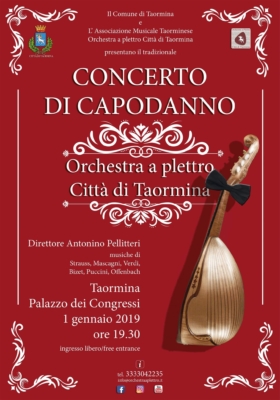
The Town of Taormina and the Taormina Plectrum Orchestra presents

The New Year’s Concert

Taormina Congress Hall @ 7.30pm

Free entrance


Antonio Pellitteri will conduct the Orchestra as usual. Music by Strauss, Mascagni, Verdi, Bizet, Puccini, Offenbach


More info
Plectrum Orchestra Town of Taormina: info@orchestraplettro.it – T. 0039 333 3042235 (mobile) – FB page


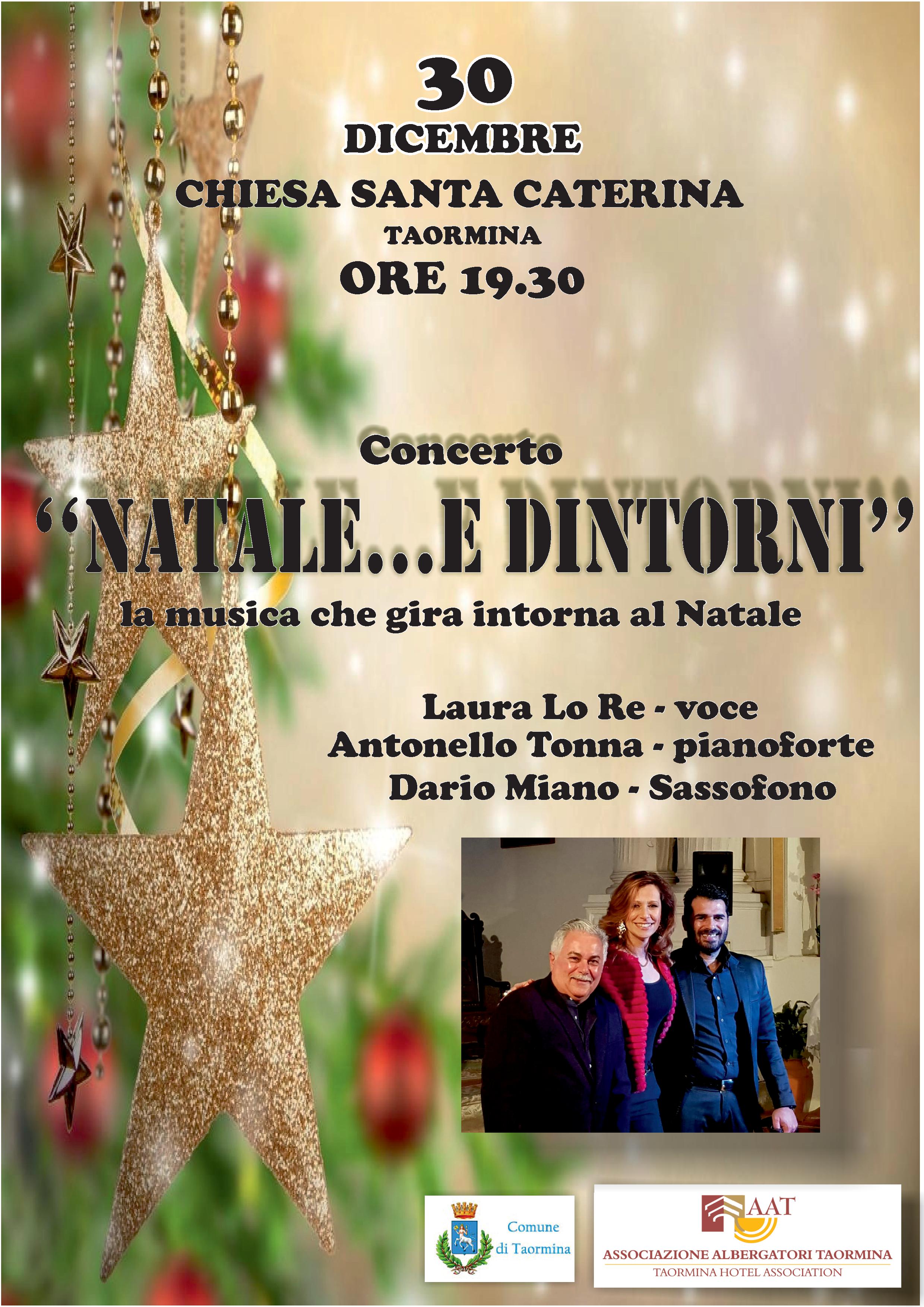
Natale… e dintorni

musics “around” Christmas

Church of Santa Caterina (via Giovanni di Giovanni), Sunday 30th Decemver 2018 @7.30pm


Laura lo Re: voice

Antonello Tonna: piano

Dario Miano: sax

Living Presepe – Living Nativity Scene

… e la Luce brillò… Venite e vedete!

15th edition – 2018

From December 26 2018 to January 6 2019

Parrocchia Sacro Cuore di Gesù –Trappitello,  Taormina (ME)

FREE ENTRANCE

The presepe will be held in case of rain too.


During Christmas time in Italy, you are bound to come across cribs in homes and piazzas all over the country. Many cities also have a living crib, or a living nativity scene. It is thought that St. Francis hosted the first living nativity scene in 1223, sparking a tradition that continues in Italy to this day. Beginning on Christmas day, and running until January 6th, towns throughout Italy hold pageants to re-act the night of Jesus’ birth. Actors portray Mary, Joseph, the three Magi and other biblical figures from the gospel.

In Trappitello, hamlet of the town of Taormina, every year in Chrismas time, a Living Crib with about 150 actors and “walk-ons” is organised. It is one of the most appreciated living cribs of Sicily and in fact last year 23.000 people visited the event. The Show lasts several days, from Christmas to half January. The location set is the huge garden of the old small church of Santa Venera.

– 26 December 2018 – 5.00pm / 9.00pm
– 27 Dicembre 2018 – 6.00pm / 9.00pm
– 29 Dicembre 2018 – 6.00pm / 9.00pm
– 30 Dicembre 2018 – 6.00pm / 9.00pm
– 1 January 2019 –  6.00pm / 9.00pm
– 2 January 2019 –  6.00pm / 9.00pm
– 4 January 2019 –  6.00pm / 9.00pm
– 5 January 2019 –  5.00pm / 9.00pm
– 6 January 2019 – 5.00pm / 9.00pm

Before you leave, food tasting

How to get there:  Motorway A18 Messina/Catania, exit Taormina, Direction SS. 185 (statal road, blu sign),  500 metres from the motorway exit.
More info: T. +39 0942/50210 – M. +39 339/8320324 – +39 349/4289961

presepetrappitello@gmail.com

Facebook page: Presepe Vivente di Trappitello

Grand Christmas Concert

by Mythos Opera Festival

Ancient Theatre, Sunday 23rd December 2018 @ 5.00pm


Cast:
Erika Giannella, soprano
Stefania Vietri, soprano
Silvia Pasini, mezzo soprano
Sergio Dos Santos, tenor
Roberto Cresca, tenor

Orchestra: Giovane Orchestra Sicula, Raimondo Capizzi

Ballet directed by Elisa Laviano

Director: Mº Alberto Veronesi


TICKETS on boxol.it
Stalls (non-numbered seats): € 22,00
Upper circle (non-numbered seats): € 11,50

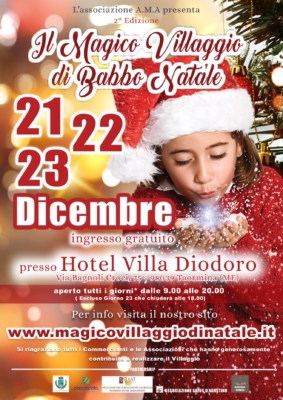
Santa Claus Village, 2nd ed.

December 21, 22 and 23 December 2018

Hotel Villa Diodoro, via Bagnoli Croci n. 75

Opening hours
Friday 2st and Saturday 22nd: from 9.00am to 8.00pm
Sunday 23: from 9.00am to 6.00pm

Free entrance


A magic world for children of all ages.
A tour starts every 30 mins and it lasts about  an hour.

Kids will have the chance to talk to Santa Claus, play with the elves , become a Santa Claus little helper in the his toy’s factroy


More info: magicovillaggiodinatale.it


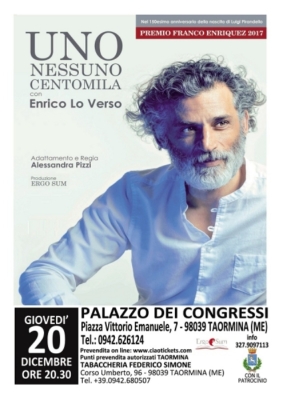
Uno Nessuno Centomila

One, No one and One Hundred Thousand

A play based on the namesake novel by Luigi Pirandello

Taormina Congress Hall, Thursday 20 December 2018 @ 8.30pm


A monolgue acted by the great Italian actor Enrico Lo Verso in a minimal stage set


Tickets

online >> soon on www.ciaotickets.com
ticket office >> Tabaccheria Federico Simone, Corso Umberto n. 96 Taormina (T. 009 0942 680507)
More info: 0039 327 9097113


Plot of  the novel
Vitangelo Moscarda discovers by way of a completely irrelevant question that his wife poses to him that everyone he knows, everyone he has ever met, has constructed a Vitangelo persona in their own imagination and that none of these personas corresponds to the image of Vitangelo that he himself has constructed and believes himself to be. The reader is immediately immersed in a cruel game of falsifiying projections, mirroring the reality of social existence itself, which imperiously dictate their rules. As a result, the first, ironic “awareness” of Vitangelo consists in the knowledge of that which he definitely is not; the preliminary operation must therefore consist in the spiteful destruction of all of these fictitious masks. Only after this radical step toward madness and folly in the eyes of the world can Vitangelo finally begin to follow the path toward his true self. He discovers, though, that if his body can be one, his spirit certainly is not. And this Faustian duplicity gradually develops into a disconcerting and extremely complex multiplicity. How can one come to know the true foundation, the substate of the self? Vitangelo seeks to catch it by surprise as its shows itself in a brief flash on the surface of consciousness. But this attempt at revealing the secret self, chasing after it as if it were an enemy that must be forced to surrender, does not give the desired results. Just as soon as it appears, the unknown self evaporates and recomposes itself into the familiar attitudes of the superficial self. In this extremely modern Secretum where there is no Saint Augustine to indicate, with the profound voice of conscience, the absolute truth to desire, where desperation is entrusted to a bitter humorism, corrosive and salvific at the same time, the unity of the self disintegrates into diverse stratifications. Vitangelo is one of those “…particularly intelligent souls …who break through the illusion of the unity of the self and feel themselves to be multiform, a league of many Is…” as Hermann Hesse notes in the Dissertation chapter of Steppenwolf.

Vitangelo’s extremely lucid reflections seek out the possible objections, confine them into an increasingly restricted space and, finally, kill them with the weapons of rigorous and stringent argumentation. The imaginary interlocutors, (“Dear sirs, excuse me”…”Be honest now”…”You are shocked? Oh my God, you are turning pale”…), which incarnate these objections rather than opening up Vitangelo’s monologue into a dialogue fracture it into two levels: one external and falsely reassuring, the other internal and disquieting, but surely more true. The plural you (“voi”) which punctuates like a returning counterpoint all of the initial part of the novel is much different from the “tu” of Eugenio Montale, which is almost always charged with desperate expectations or improbable alternatives to existence; it represents, rather, the barrier of the conformist conceptions which the lengthy ratiociations of Vitangelo nullify with the overwhelming evidence of implacable reflections.

Vitangelo’s “thinking out loud”, definitely intentional and rigorous, is, however, paradoxically projected toward a completely different epilogue in which the spiral of reasoning gives way to a liberating irrationalism. Liberation for Vitangelo cannot happen through instinct or Eros, as happens in the case of Harry Haller, the steppenwolf, who realizes his metamorphosis through an encounter with the transgressively vital Hermine. Vitangelo’s liberation must follow other avenues; he must realize his salvation and the salvation of his reason precisely through an excess of reason. He seems to say to us: “Even reason, dear sirs, if it is alleviated of its role as a faculty of good sense which councels adaptation to historical, social and existential “reality”, can become a precious instrument of liberation.” This is not true because reason, when pushed to its ultimate limits, can open up to new metaphysical prospects, but because, having reached its limits, deliriously wandering around in cerebreal labyrinths and in an atmosphere satured with venom, it dies by its own hand. The total detachment of Vitangelo from false certainties is fully realized during a period of convalescence from illness. Sickness, in Pirandello as in many other great writers, is experienced as a situation in which all automatic behavior is suspended and the perceptive faculties, outside of the normal rules, seem to expand and see “with other eyes.” In this moment the ineptitude that Vitangelo shares with Mattia Pascal and other literary characters of the beginning of the 20th century demonstrates its positive potential and becomes a conscious rejection of any role, of any function, of any perspective based on a utilitaristic vision. The episode of the woolen blanket signals the unbrigeable distance which now separates Vitangelo from the rules of reality in which the judge who has come to interrogate him appears to be completely enmeshed. While the scrupulous functionary, completely absorbed in his role, collects the useful elements for his sentencing, Vitangelo contemplates with “ineffable delight” the woolen blanket covering his legs: “I saw the countryside: as if it were all an endless carpet of wheat; and, hugging it, I was beatified, feeling myself truly, in the midst of all that wheat, with a sense of immemorial distance that almost cause me anguish, a sweet anguish. Ah, to lose oneself there, lay down and abandon oneself, just like that among the grass, in the silence of the skies: to fill one’s soul with all that useless blue, sinking into it every thought, every memory!”

Once cured of his illness, Vitangelo has a completely new perspective, completely “foreign”. He no longer desires anything and seeks to follow moment by moment the evolution of life in him and the things that surround him. He no longer has any history or past, he is no longer in himself but in everything around and outside of him.
(source: Wikipedia)
Ponti Svelati

Paint exhibition of the Persian painter Safari Rasta

Palazzo Duchi d Santo Stefano, from Sunday 6 December 2018 to Tuesday 8 January 2019

Opening hours: Tuesday to Sunday, from 9.00am to 2.00pm

free entrance


On the 70th anniversary of the Universal Declaration of Human Rights adopted by the United Nations General Assembly on December 10th 1948, the Fondazione Mazzullo presents the exhibition of the Persian painter  Safari Rasta.


Info: + 39 095 532402 – +39 095 340 1295592 (mobile)

More info: beniamingroup.com

FB page: facebook.com/pg/Behnam-Beniamin-Art

Antiquitatis Volumina

Incunaboli e Cinquecentine
Incunabula and fifteeners

Town Library, Piazza IX aprile

From December 15th 2018 to September 15th 2019

Opening hours: everyday except Mondays from 9.00am to 1.00pm and from 3.00pm to 7.00pm

Free entrance


Exhibition of ancient books dating back to the 15th and 16th century.

An incunable, or sometimes incunabulum (plural incunables or incunabula, respectively), is a book, pamphlet, or broadside printed in Europe before the year 1501. (Importantly, incunabula are not manuscripts). A “fifteener”, is a book printed in the 16th century