
• IntroWho we are
    • Introduction 
    • How to reach us 
    • Contact us 
  • What to seemonuments…
    • Going through the town 
    • Monuments 
    • Churches 
    • Events 
    • Photo Gallery 
  • What to doactivities
    • list of what to do 
    • Excursions 
    • Golf 
  • Where to staylist of hotels
  • Much more 
    • Taormina Webcams 
    • Climate in Taormina 
    • Beaches 
    • Language School 
    • Congress Center 
    • Food & Wines 
    • Surroundings 
    • Useful lists 
You are here: Home » What to see » Monuments
  • Latest News

    2013

    Taormina Events Calendar 2013

    January 2013 December 1st 2012 / January 6th 2013 - Taormina Christmas » more

    taofest_

    June 15/22 – Taormina Film Fest

    Taormina Film Fest 2013 Greek Theatre and Taormina Congress Hall, from » more

    gerardo_sacco_ICONA

    June 15/22 – Gerardo Sacco

    Jewelry exhibition by Gerardo Sacco

    previous Church of San » more

    Il Cinema sopra Taormina_icona

    June 16 / September 30 – Il cinema sopra Taormina

    Exhibition: “Il cinema sopra Taormina” June 16 / September 30 – » more


  • Climate in Taormina

Monuments

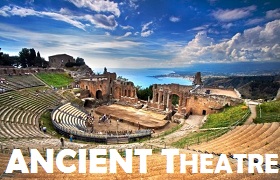
The Greek-Roman Theatre

Is it Greek or Roman? This is a question that has always been open to debate among experts and critics. All their disputes would end if they remembered Taormina’s origins as a Greek “Polis” and the fact that each and every ancient Greek town had its own Theatre where they performed tragedies by Aeschylus, Sophocles and Euripides and comedies by Aristophanes, just to name the most famous authors. The Theatre in Taormina is the second-largest in Sicily after the one in Siracusa. All the Romans did later, in accordance with their well-known ostentatious nature, was enlarge the theatre as it was very small. And it apparently took decades to build. It is fifty metres wide, one hundred and twenty metres long and twenty metres high, which means that about 100,000 cubic metres of stone had to be removed. Further evidence that the Theatre is of Greek origin is in the well-cut bricks of Taormina stone (similar to marble) below the scene of the Theatre; these are a typical example of the ancient Greek building technique. The theatre is divided into three main sections: the scene, the orchestra and the cavea. The scene is opposite the cavea and is obviously where the actors used to perform. There is now a large ten-metre long portion missing in the centre of the scene, supposedly caused by attacks during the wars. This serious damage to the theatre makes it nevertheless even more evocative due to the magnificent panorama (the bay of Naxos and Mount Etna) which can now be seen. According to reconstructions by experts, the scene was decorated with two series of columns of the Corinthian order, recognizable due to the shape of the capitals and their acanthus leaf design; the acanthus is a wild Mediterranean plant. The orchestra of the theatre was the flat clearing in the centre which separated the scene from the cavea. This area was for the musicians, but the choruses and dancers also performed there. The word “orchestra”, nowadays meaning a musical band, comes from this part of the Greek theatre. The cavea on the other hand is the series of steps, from the lowest to the highest ones at the top, where the spectators were seated. The first and last semicircular steps were 62 and 147.34 metres long respectively. The steps were carved out of the rock and, in places where there was none, they were built in masonry.
The theatre is thought to have been able to seat about 5,400 spectators. No one is sure of when the Theatre was actually erected. Those who believe it was built by the Greeks say it must have been around the middle of the third century B.C., when Hiero was the tyrant of Siracusa. But due to the theatre’s structural characteristics, some say it was erected by Roman engineers to be used exclusively by the Greeks. This would explain all the Greek inscriptions inside the theatre. Nowadays the ancient Theatre is still one of Taormina’s main attractions. As it is still practicable, the theatre seated the audiences of the most important Italian cinematographic event, the “David di Donatello” award, for many years; now an international festival entitled “Taormina Arte”, lasting the whole summer period, is held there with cinema, theatre, ballet and symphonic music reviews.

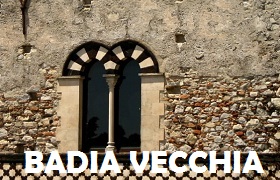
Badia Vecchia

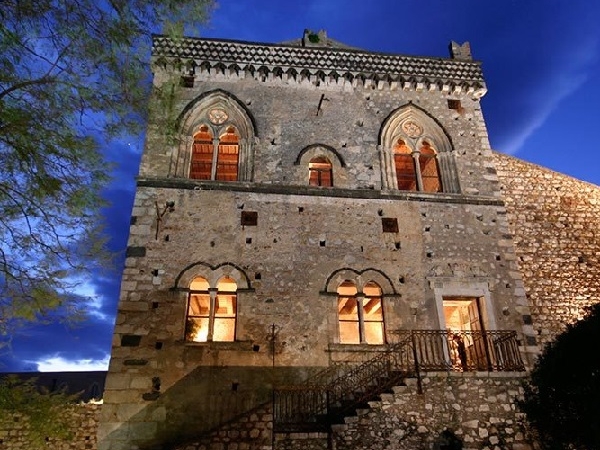
Badia VecchiaAs in the case of Palazzo Duca di S. Stefano, Badia Vecchia was purchased by the Municipality of Taormina in 1960 for 12 million lire. It was at first restored but then abbandoned once again and left to the mercy of vandals. Armando Dillon, a Neopolitan architect, is of the opinion that this building was called Badia Vecchia due to the fact that it was at one stage the home of Mother Abbess Euphemia, who was a regent of the Kingdom of Sicily from 1355 in the name of her younger brother Frederic IV, known as “the Simple”. But this is only a theory, even though it is a suggestive one. It does seem, however, that the mansion is called Badia Vecchia because it once was an abbey. This theory is based on the discovery of a sacred painting at the bottom of a rain-water well and it seems that the painting was hidden there so as to save it from one of the many invasions on Taormina. And all the niches inside were then thought to be niches for icons and not just simple storage spaces. The Gothic architecture of Badia Vecchia is very similar to that of Palazzo Duca di S. Stefano. It therefore follows that the two buildings are of the same period, in other words, the late 1300s. The Gothic style of this building too is therefore influenced by Arabian and Norman art. Badia Vecchia is formed by three rooms having the same surface area. A frieze of inlaid lavic stone and white Siracusa stone decorates the building, marking the dividing line between the first and second floors. Three magnificent mullioned windows rest on the frieze one beside the other so that they resemble a single window with six openings. The ogival arches decorating the side windows have a single rosette while the ogival-arched central window has three. The top of all the facades of Badia Vecchia is decorated with swallow-tailed merlons, making it resemble a fortress-like tower. Badia Vecchia, like Palazzo Duca di S. Stefano, was built as a stronghold along the boundary walls, the former to protect the northern part of the town and the latter the southern part.

Palazzo Corvaja

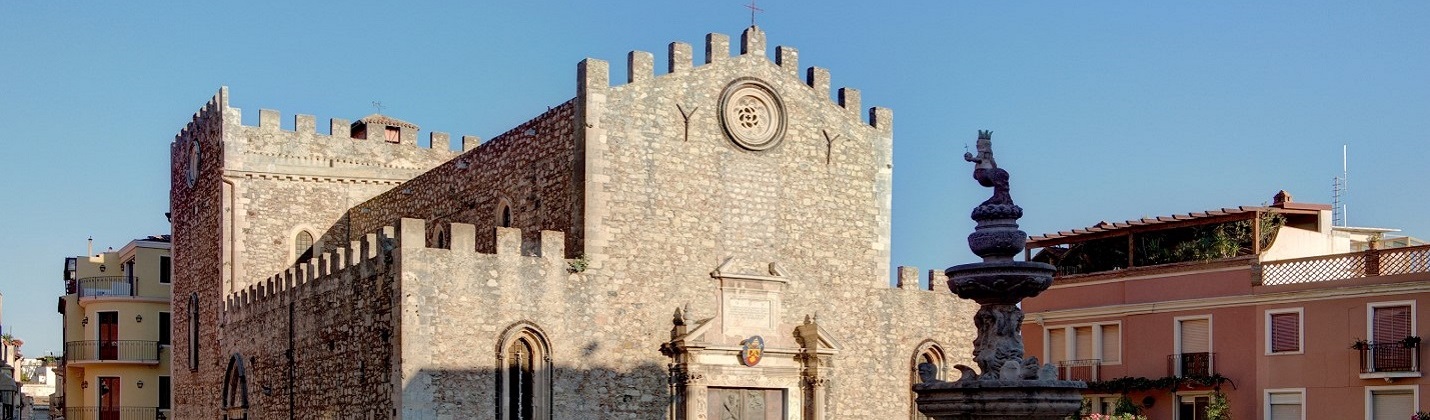
Palazzo CorvajaThe Arabian dominion in Sicily lasted from the 9th to the 11th century and the Moslems remained in Taormina in particular from the year 902 to 1079. During the 11th century the Arabs reinforced the town’s defences by building, among other things, a tower which is really the main part of today’s Palazzo Corvaja. The cubic tower reminded the Arabs of their sacred “Al Ka ‘bah” which, according to Mahomet, was the first tempie erected to God by Abraham at the Mecca. The tower was extended at the end of the 13th century with the addition of the area which is on the left of the entrance portal. Together with this new wing, a staircase was built leading from the courtyard to the first floor. And on the landing there are three magnificent panels in Siracusa stone scuplted in high-relief: the first one pictures the creation of Eve; the second panel, the originai sin; and the third is of the expulsion of Adam and Eve from Paradise. The right wing of the building was constructed at the beginning of the 1400s in order to house the meetings of the Sicilian Parliament which were held, the first in 1411, in the large 15th century hall in the presence of Queen Bianca of Navarra, regent of the Kingdom of Sicily. And for this same reason Palazzo Corvaja is also called Parliament House or the Palace of Queen Bianca of Navarra. In any case the mansion is named after the Corvaja family, one of the oldest and most noble families in Taormina. The men of the family have been renowned in the administration of the town as well as in arts and magistrature. Palazzo Corvaja was in a pitiful state of total neglect with several families living there at the one time until the end of the Second World War in 1945. That same year the first mayor of Taormina had the building dispossessed and Armando Dillon, a Neopolitan architect, restored it all from 1945 until 1948. In 1960 Palazzo Corvaja was enlarged and the new wing now houses the offices of the “Servizio Turistico Regionale”, the Tourist Office. Near the Odeon, just a few steps away from the Zecca, near the old entrance to the Naumachiae and not far from the Greek-Roman Theatre, Palazzo Corvaja is certainly one of Taormina’s historical landmarks. As regards the architectural style of the building, it is a mixture of styles due to the different eras during which it was built and extended. Its styles go from Arabian to Norman to Gothic. The battlements of the tower are Arabian and are formed by a double row of square holes surmounted by small merlons. The mullioned windows of the 14th century hall are Gothic. This type of window in Gothic architecture is divided by a small column so as to create two entrances for the light. The 15th century hall, where the Sicilian Parliament meetings were held, is all in Norman style.

The Antiquarium

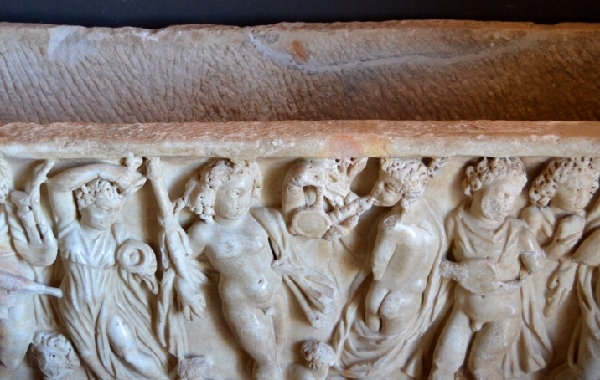
The Antiquarium is a small archeological museum on show in two rooms of the Antique Theatre guardian’s house, once called the House of the Englishmen because it was supposedly inhabited by English families during the first days of tourism in Taormina. Few archaeological specimens remain in this house-museum since most of them are now in Naples, Messina and Siracusa. One of the most interesting things is a large square block of Taormina marble, formerly the base of a statue. On the front of this base an inscription reads “The Tauromenitani (the Taormina people) dedicate this statue to Olympio, winner of the horse race in the games at Olympia”, evidence that Taormina had a winner at the Olympic Games. This statue base was found in 1770 while extension work was being carried out in the “S. Maria del Valverde” monastery, which is now a Carabineri post in Vittorio Emanuele (Badia) square. Another statue base in Taormina marble, according to the inscription on it, was dedicated to Caius Claudius Marcellus, Propraetor of Sicily in the year 77 B.C. A 1.75 metre pillar in Taormina marble, discovered in 1864, is called the “Tavola degli Strateghi” (Table of the Strategists), a slab engraved with the names of the strategists, who were not soldiers but those in charge of administering justice in Taormina. Another pillar is the “Tavola dei Ginnasiarchi” (Table of the Gymnasiarchs), magistrates in charge of the Gymnasium where the young men were educated psychologically and physically. There is also an interesting small oval sarcophagus in marble, probably made for a child. lt is sculpted externally in high-relief with Baccanal scenes involving children. The sarcophagus was discovered in 1839 in the gardens of what was then a Franciscan Friary, now a nursing home run by the Franciscan Missionaries of Mary. Some stone bricks can also be seen, the top surfaces of which are lapped and engraved with financial statements of the Polis. These were found in 1833 at the base of the Greek-Roman Theatre. Therefore in Taormina, as in Rome and Athens, documents related to the political, civil and financial system of the town were conserved “for eternity” as they were engraved on stone.

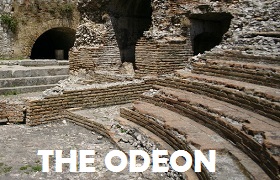
The Odeon

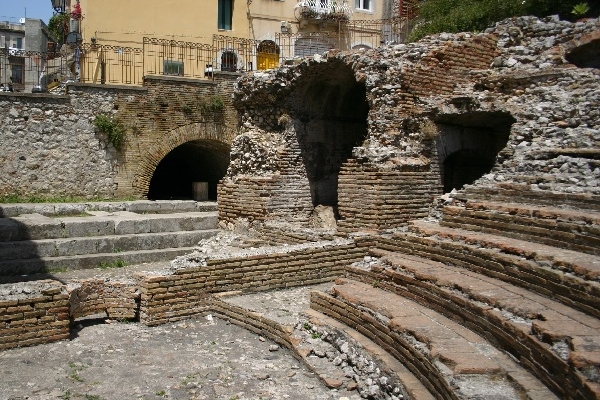
OdeonThere are no doubts as to the origins of the Odeon, or “small theatre”. It was built directly by the Romans when Taormina became a military colony in the year 21 B.C. under Caesar Augustus Octavian, the first Roman emperor. Much smaller than the other theatre, it is evidence of how important culture was to Taormina in those days. The small theatre is just behind a hill named after St. Catherine of Alexandria in Egypt, near Palazzo Corvaja. lt was found accidentally on June 5th 1892 and until that moment no one had even suspected it existed. The story of its discovery is an unusual one. A blacksmith named Antonio Bambara was digging in his land behind St. Catherine’s Church when his pick uncovered a red brick construction. A year later the real excavations began and the Odeon appeared, badly damaged in various sections. The architecture of the Roman Odeon is almost identical to that of the larger theatre. The monument is oriented differently. In fact the Greek-Roman Theatre faces the south while the small Odeon faces north-east. lt was built with lateritious material, in other words with large clay bricks joined together with lime. The Odeon has the same construction plan as all other Roman theatres and is divided into three main sections: the scene, the orchestra and the cavea. The scene of the Odeon consisted of the stylobate (base) and the peristyle (colonnade) of a Greek temple, some say dedicated to Aphrodite, which was discovered during the excavations on the Odeon. Apart from theatrical performances, this small Odeon, built right in the centre of the Polis, is thought to have been used for musical recitals and auditions reserved to magistrates, important civil, military and religious people and their families as well as to guests of consequence.

Palazzo Duca di S. Stefano

Palazzo CorvajaThe palace’s square structure, massiveness, position and battlemented walls make it look like a fortress, therefore making people think that the initial constructor was a Norman. This 13th century palace, situated near Porta Catania, has a beautiful garden in front of its main facades facing east and north and was the home of the De Spuches, a noble family of Spanish origin, who were Dukes of S. Stefano di Brifa and Princes of Galati, two towns on the Jonian coast in the Messina area.
Palazzo Duca di S. Stefano is surely one of the masterpieces of Sicilian Gothic art, in which the elements of Arabian and Norman art merge. Arabian reminiscences are aroused by the decoration on the top part of the palace: a wide frieze runs along the east and north facades formed by a wavy decoration in lavic stone alternated with rhombus-shaped inlays in white Siracusa stone, together forming a magnificent lace of marquetry. Norman art instead is recalled by its square tower-like plan and by what remains of the swallow-tailed merlons on the top of the building. The Palace is made up of three square overlapping sections. The entrance to the ground floor is an ogival arch constructed with squared bricks of black basalt (lavic stone) and white granite (Taormina stone). The first floor was reached by means of drawbridges and moving staircases through the small door which can still today be seen between the two mullioned windows on the first floor. An internal staircase, made entirely of wood, was reproduced when the building was restored, in the 18th century. On the second floor there are four beautiful windows indisputably in Gothic style, two facing east and two facing north, the noble prospects of the palace. The four mullioned windows have an elaborate structure with rosettes and small trilobe arches as well as triple cordons framing the ogival arches. A column of pink granite stands in the middle of the ground floor and is thought to have once been in the Greek Theatre. In the gardens overlooked by the noble facades there is a well for the collection of rain-water (a puteal) which was the water supply for the whole palace. The municipality of Taormina only gained possession of Palazzo Duca di S. Stefano in 1964 when it was bought for 64 million lire (about € 33.000,00) from Vincenzo De Spuches, a young descendant of the De Spuches family, who lived in Palermo.
Palazzo Duca di S. Stefano today houses the Mazzullo Foundation, run by a clever sculptor who has succeeded in turning tradition into modernness. Many of his sculptures are on show in the palace. It is a location for civil weddings and temporary exibitions.

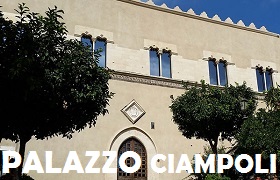
Palazzo Ciampoli

Palazzo CiampoliPalazzo Ciampoli is the most recent of the mediaeval mansions in Taormina, since its origin dates back to the beginning of the 15th century. The year in which this splendid mansion was built was 1412 and the coat-of-arms above its main entrance portal bears this date. In 1926 the “Palazzo Vecchio” Hotel was built in the gardens of Palazzo Ciampoli and architecturally the hotel vaguely recalled the famous “Palazzo Vecchio” or “Palazzo della Signoria” in Florence. Until a few years ago, Palazzo Ciampoli housed one of Taormina’s most famous night clubs, “Sesto Acuto”, named after the ogival arches which ornate the building according to the Gothic style that it recalls. Since two coats-of-arms, one with a shield and a flag, the other with a shield and three stars, can be found in both Palazzo Ciampoli and Palazzo Corvaja, the former is thought to have been owned by the Corvaja family before being passed on to the Ciampoli family. The only noticeable part of Palazzo Ciampoli is its front prospect resting on a set of wide and steep steps which act as its natural base. Originally there was a large open courtyard in front of the building but all that remains of it today is a round-arched portal with its base in Taormina marble and two bas-reliefs of the heads of roman emperors in the corners above the arch. The mansion was hit and destroyed by bombings in 1943. The above-mentioned portal, however, was later reconstructed with the same marble slabs that had collapsed. The Catalan architecture in Palazzo Ciampoli is easily recognized. In fact the structure of the building has Spanish characteristics: in its short northern prospect there is a single window whose arch is outlined by an architrave-panel with lobes connected to form festoons sculptured all along it. The top of its main prospect is ornated with small triangular merlons which, however, are not as majestic as the swallow-tailed merlons to be found on the other mediaeval constructions in Taormina.
  • What to see

    • Going through the town
    • Monuments
    • Churches
  • What to do

    • List of activities to do
    • Golf
    • Excursions
  • Where to stay

    • Charming
    • Romantic
    • Boutique
    • Luxury

Search our website

  • Home
  • Introduction
  • What to see
  • Where to stay
  • Taormina Webcams
  • Weather in Taormina
  • Contact us
© Taormina friends Club 2013 - RCP Web Design